


Wildfire Careers in Canada: Jobs Beyond Firefighting
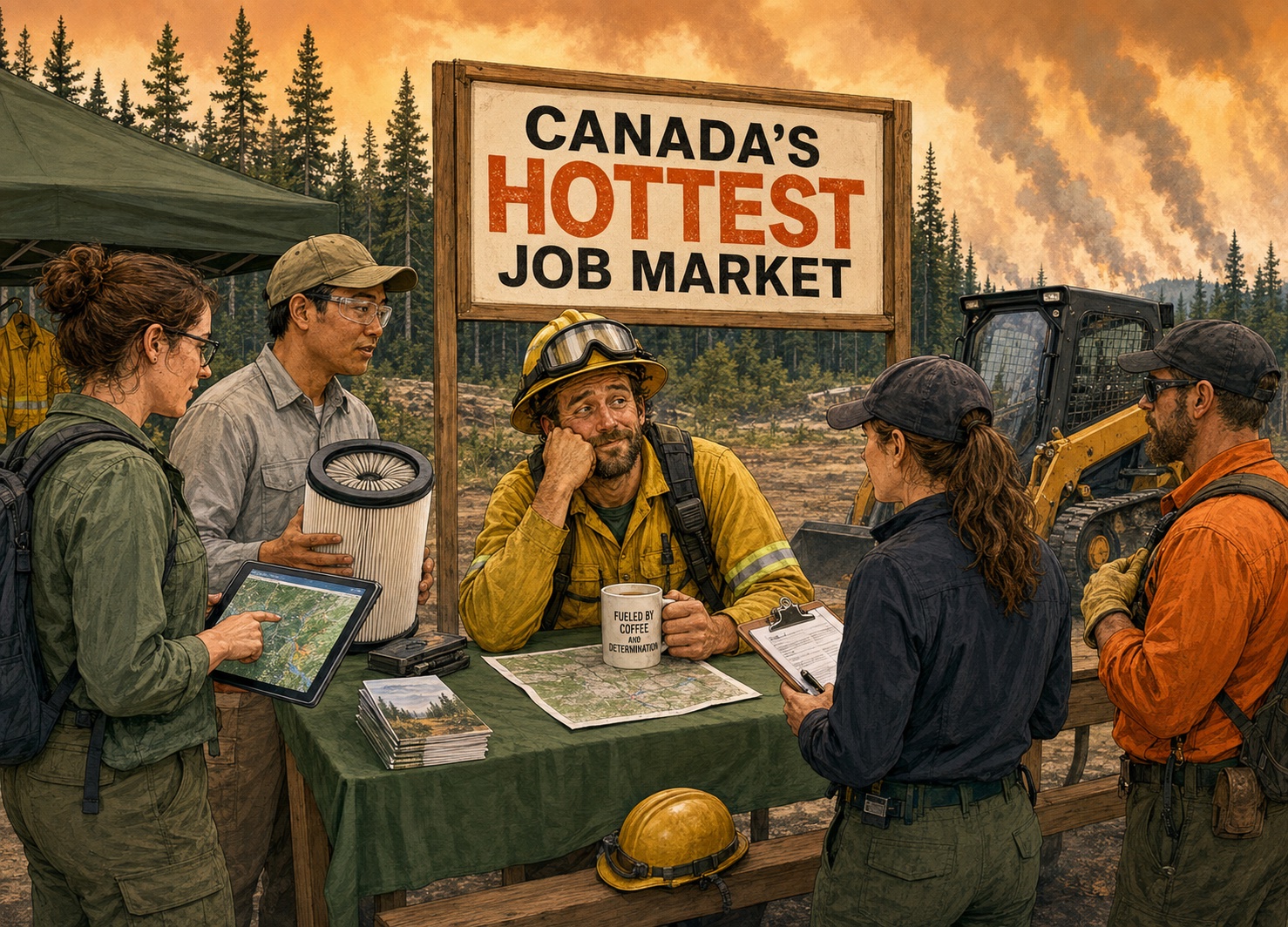
Wildfires are no longer only a seasonal problem in remote forests. Smoke reaches major cities, communities face repeated evacuations, and governments are spending more on prevention, monitoring, emergency response and recovery.
That is creating work well beyond the fire line.
Some are established jobs receiving more investment. Others are existing occupations developing a wildfire specialization.
Wildfire Careers at a Glance
| Career area | Example jobs | Employment pattern |
|---|---|---|
| Fire response | Wildland firefighter, crew leader, equipment operator | Established and often seasonal |
| Operational support | Dispatcher, logistics coordinator, aviation support | Seasonal and permanent positions |
| Prevention | FireSmart coordinator, fuel management technician, risk assessor | Growing through public investment |
| Technology | GIS analyst, remote sensing specialist, fire behaviour analyst | Specialized and increasingly important |
| Health and air quality | Air quality specialist, environmental health officer, occupational hygienist | Existing careers with expanding wildfire duties |
| Emergency management and recovery | Evacuation coordinator, insurance adjuster, restoration specialist | Demand rises during and after major fires |
Canada needs more than firefighters. Wildfire response also requires logistics, technology, health, construction, planning and communications professionals.
Why Wildfire Work Is Expanding
Canada recorded more than 6,000 wildfires and over 8.3 million hectares burned in 2025, making it the country’s second-worst wildfire season on record.
By 2026, Canada could mobilize as many as 15,000 professional and volunteer fire personnel over the course of a year. More than 2,000 had recently received training through newer federal programs.
Government investment now supports FireSmart programs, vegetation management, satellite monitoring, research and community risk reduction. This does not guarantee permanent growth, but it shows where specialized work is appearing.
1. Firefighting and Operational Support
Wildland firefighters suppress fires, establish fire guards, operate pumps and remove combustible material. The work is hazardous and commonly seasonal, with long shifts and remote assignments.
Entry requirements differ by province. Ontario applicants without previous experience generally need SP100 wildland firefighter training and must pass the WFX-FIT physical test. British Columbia also requires applicants to meet fitness and other eligibility standards.
The BC Wildfire Service employs approximately 1,600 seasonal personnel each year and reports around 200 provincial fire-job openings during a typical season.
Fire operations also require:
- Dispatchers and radio operators
- Lookout observers and detection aides
- Equipment operators and mechanics
- Warehouse and supply workers
- Aviation support personnel
- Logistics coordinators and wildfire investigators
These roles can suit people from transportation, warehousing, aviation, telecommunications, emergency services or heavy equipment.
2. FireSmart and Wildfire Prevention
FireSmart programs assess communities, remove combustible vegetation and help planners and builders reduce the likelihood that fire will spread through populated areas.
Related positions include FireSmart coordinator, wildfire mitigation specialist, community wildfire resiliency coordinator, risk assessor, fuel management technician and vegetation management worker.
Federal and provincial governments announced $104 million in FireSmart-related investments in 2025. The plans included up to six new prevention and mitigation positions in Newfoundland and Labrador, two FireSmart implementation staff in Prince Edward Island, and dedicated prevention positions in New Brunswick.
This work draws on forestry, planning, landscaping, construction, education and program-management experience.
3. Technology, Mapping and Wildfire Intelligence
Modern wildfire response depends on maps, weather data, satellite imagery and predictive models. Canada’s WildFireSat mission is designed to monitor active fires daily and help agencies decide where crews and aircraft should be deployed.
Related careers include:
- GIS analyst or technician
- Remote sensing specialist
- Geospatial data scientist
- Fire behaviour analyst
- Wildfire research technician
- Meteorologist
- Software or data engineer
These positions are not usually entry level. Employers may require education in geomatics, geography, computer science, environmental science, forestry or meteorology.
4. Air Quality and Public Health
Wildfire smoke can affect communities thousands of kilometres away. Public health authorities monitor exposure, issue guidance and plan cleaner-air spaces. Related occupations include air quality specialist, environmental health officer, epidemiologist, occupational hygienist and environmental engineer.
Building operators and HVAC professionals may also become more involved in filtration, ventilation and indoor-air planning. These are not entirely new careers. The emerging opportunity is wildfire-smoke expertise within established health, environmental and building occupations.
5. Emergency Management and Recovery
Large wildfires require evacuations, shelters, transportation, temporary housing and public communication.
Relevant positions include emergency management coordinator, evacuation planner, shelter coordinator, emergency social services worker, logistics officer, public information officer and recovery program coordinator.
Employment continues after a fire is contained. Communities may need insurance adjusters, damage assessors, restoration technicians, engineers, environmental consultants, construction trades and recovery case managers.
Recovery can last for years, but individual jobs may be temporary or contract based.
Preparing for Wildfire-Related Work
Candidates need more than a general interest in wildfire response. Employers look for evidence such as:
- First aid, safety training and hazard assessment
- Working effectively under pressure
- Coordinating people, equipment or supplies
- Experience in remote or difficult conditions
- GIS, forestry, environmental or emergency-planning knowledge
- Clear public and inter-agency communication
Use the language found in the posting. Useful search terms include wildland fire, FireSmart, fuel management, remote sensing, GIS wildfire, air quality, emergency management and disaster recovery.
The Real Employment Outlook
Wildfire employment in Canada now extends from the fire line to satellites, public health offices, municipal planning departments and recovery sites.
The clearest opportunities are in direct response, community risk reduction and technical decision support. Some growth will appear as wildfire duties added to existing professions rather than entirely new occupations.
Applicants should remain realistic. Many positions are seasonal, geographically restricted or dependent on public funding. Technical jobs may require several years of education or related experience.
Even with those limitations, wildfire work is becoming broader and more specialized across the Canadian labour market.