

Are you using present or past tenses on your resume?
Are You Using Present or Past Tense on Your Resume?
A Resume Documents Experience Already Gained
Consider someone who has managed a department for five years. They may still be managing that department today, but the experience did not suddenly begin this morning. They have already supervised employees, addressed operational challenges, prepared reports and made decisions over those five years.
Those activities form part of their established professional experience. Past tense communicates that the work has been performed, without requiring the reader to determine whether each activity is still taking place.
The purpose of a resume is to show an employer what you bring to the position. It should describe the responsibilities you have handled and the contributions you have made, rather than simply repeating the duties listed in a job description.
Current Employment Does Not Require Present Tense
Consider two ways of describing the same work:
Present tense: “Manage a team of 20 employees and oversee daily operations.”
Past tense: “Managed a team of 20 employees and oversaw daily operations.”
The second statement clearly identifies experience already acquired. It does not suggest that the person stopped supervising employees or left the organization.
That information belongs in the employment dates. A heading such as Operations Manager | 2023–Present already tells the reader that the position is ongoing. The statements beneath it can then concentrate on the work performed.
In other words, the date range tells the reader when you held the position, and the bullet points explain what you did.
Consistency Makes a Resume Easier to Follow
Consider a current position in which someone manages staff, prepares budgets and recently completed a major systems implementation. Switching between present tense for recurring responsibilities and past tense for a completed project introduces an unnecessary difference in writing style.
Using past tense for every statement provides a uniform approach:
Operations Manager | 2022–Present
- Managed daily operations across three departments employing 45 staff members.
- Developed annual budgets and monitored departmental expenditures.
- Implemented a new scheduling system that reduced administrative processing time by 20%.
- Coordinated employee training, performance evaluations and workforce planning.
The examples include recurring responsibilities and a completed achievement. Each begins in past tense, while the employment dates make clear that the job continues. There is no need for a separate tense rule for every type of statement.
Focus on What You Actually Did
Choosing the right tense is useful, but the substance of each statement matters more. A resume should explain the work performed and, where appropriate, the scale or outcome of that work.
Less optimal: “Responsible for managing client accounts.”
Improved: “Managed 45 commercial accounts and increased annual revenue by 12%.”
The second statement is more informative. It identifies a responsibility, gives a sense of scope and includes a result. Its value comes from the additional detail, not simply from changing a verb to past tense.
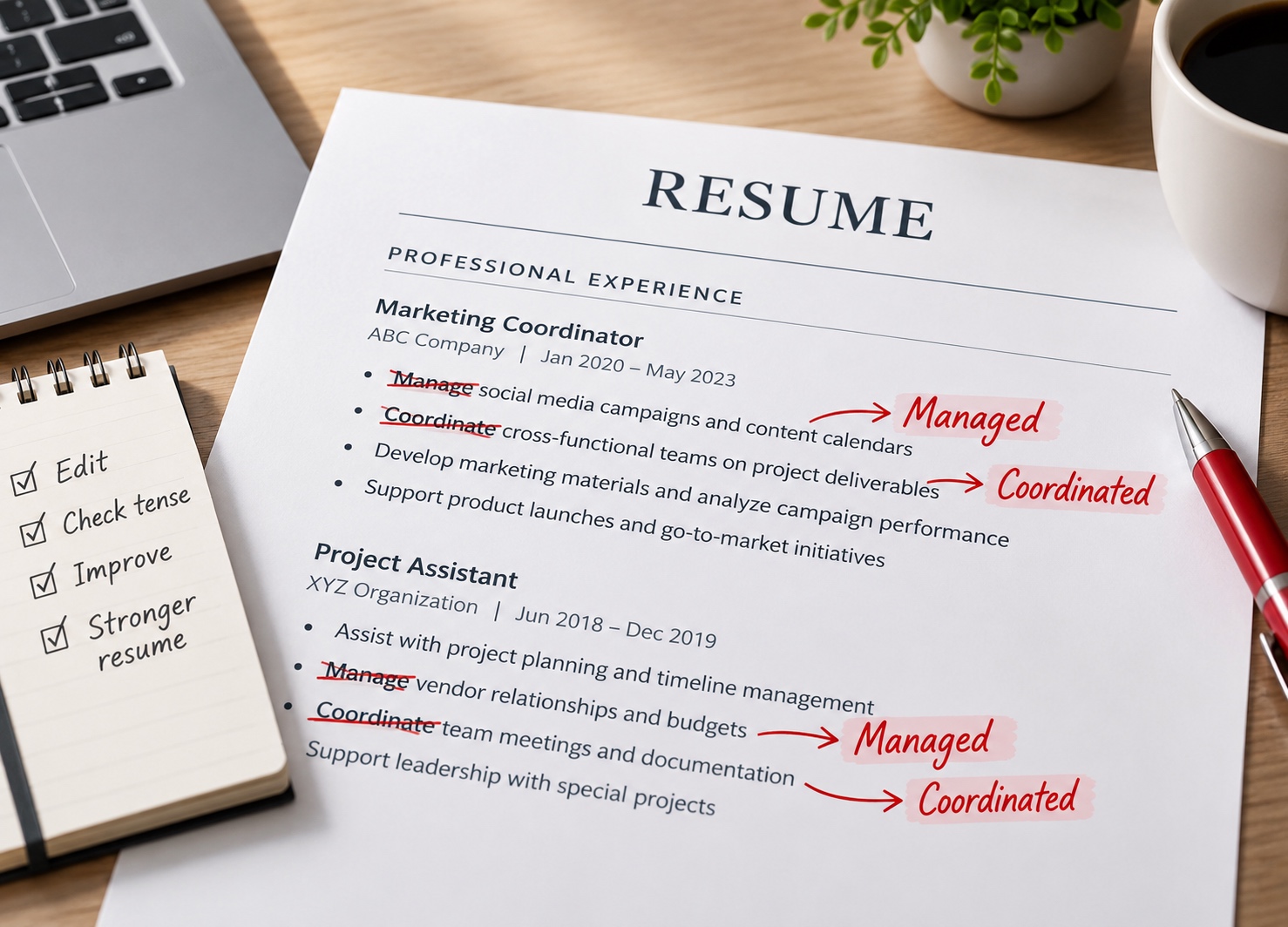
Begin statements with clear action verbs such as Managed, Developed, Coordinated, Implemented, Improved or Resolved. Avoid unnecessary openings such as “Was responsible for” or “Was involved in” when you can describe the activity directly.
Not every responsibility needs a percentage or a dollar figure. Numbers are useful when they are accurate and meaningful. The goal is to describe genuine experience, not manufacture achievements to make a statement appear more impressive.
Review Verb Tense When Updating Your Resume
Inconsistencies often appear when people revise a resume in stages. They may add a new responsibility in present tense, retain older statements in past tense and overlook the difference because each bullet was written at a different time.
When reviewing your resume, check the opening verb in each experience statement. Replace indirect descriptions with direct wording where appropriate, and make sure the responsibilities and accomplishments are represented accurately.
Be particularly careful with constructions such as “Managing a team” or “Responsible for coordinating projects.” In many cases, “Managed a team” and “Coordinated projects” are clearer and more concise.
Keep It Simple: Use Past Tense
A resume does not need different grammatical rules for current and previous employment. The dates already establish whether a position is ongoing. The descriptions should explain the work you have performed and the experience you have gained.
Using past tense throughout helps maintain consistency, simplifies future revisions and keeps attention where it belongs: on your qualifications and demonstrated contributions.
For further guidance, explore our resume writing services and resume packages for experienced professionals.